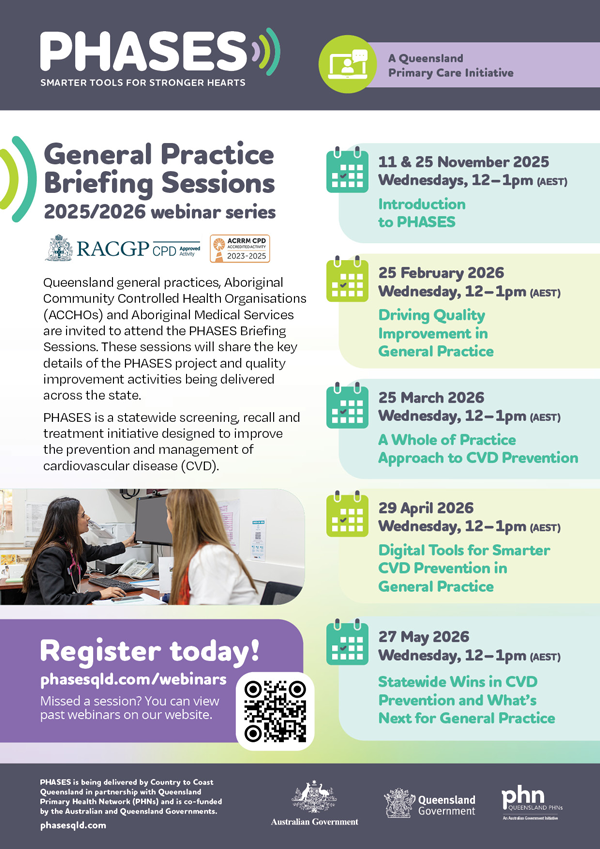
Bring your whole team — everyone plays a role in improving primary health care and outcomes for patients at risk. Webinars hosted on Microsoft Teams with interactive Q&A.
Together, we’re changing cardiovascular disease management and saving lives.
Presenters
Professor Kim Greaves
Cardiologist & Epidemiologist – Sunshine Coast Health
Dr Peter Adkins
General Practitioner & Senior Clinical Advisor – Brisbane South PHN
Learning Objectives
Describe the importance of cardiovascular disease (CVD) prevention in general practice.
Explain the roles of each member of the clinical team in CVD prevention workflows.
Apply practical strategies to embed CVD prevention without increasing consultation time.
Identify key CVD risk parameters to enhance CVD risk identification and MBS eligibility.
Identify at least 3 MBS items that support preventive CVD care.
Join another session in the series
Explore upcoming General Practice Briefing Sessions and join your team.
Funded by the Queensland Health Clinical Research Fellowship, the PHASES Linkage project connects general practice cardiovascular disease (CVD) risk data with hospitalisation and mortality data. This study aims to better understand how CVD risk impacts hospitalisation rates and assess the accuracy of the new CVD risk prediction equation in identifying high-risk individuals within Queensland’s population.
The project will:
Estimate the number of heart attacks and strokes that could be prevented with improved treatment for high CVD risk.
Identify gaps in CVD prevention to inform future care strategies.
Running in parallel with the PHASES project, PHASES Linkage highlights the power of data-driven insights to improve cardiovascular outcomes and reduce hospitalisations.